


Layered Lighting 101: Why One Overhead Light Is Killing Your Home's Vibe (2026)
Layered Lighting 101
Why One Overhead Light Is Killing Your Home's Vibe — And What to Do Instead
Interior designers say it every time: the single biggest reason a room feels flat, uninviting, or just off has nothing to do with paint color or furniture. It's the lighting. More specifically, it's relying on a single overhead fixture to do all the work — a shortcut that leaves rooms feeling like a waiting room instead of a home.
The fix isn't expensive or complicated. It's called layered lighting — and once you understand it, you'll never look at a room the same way.
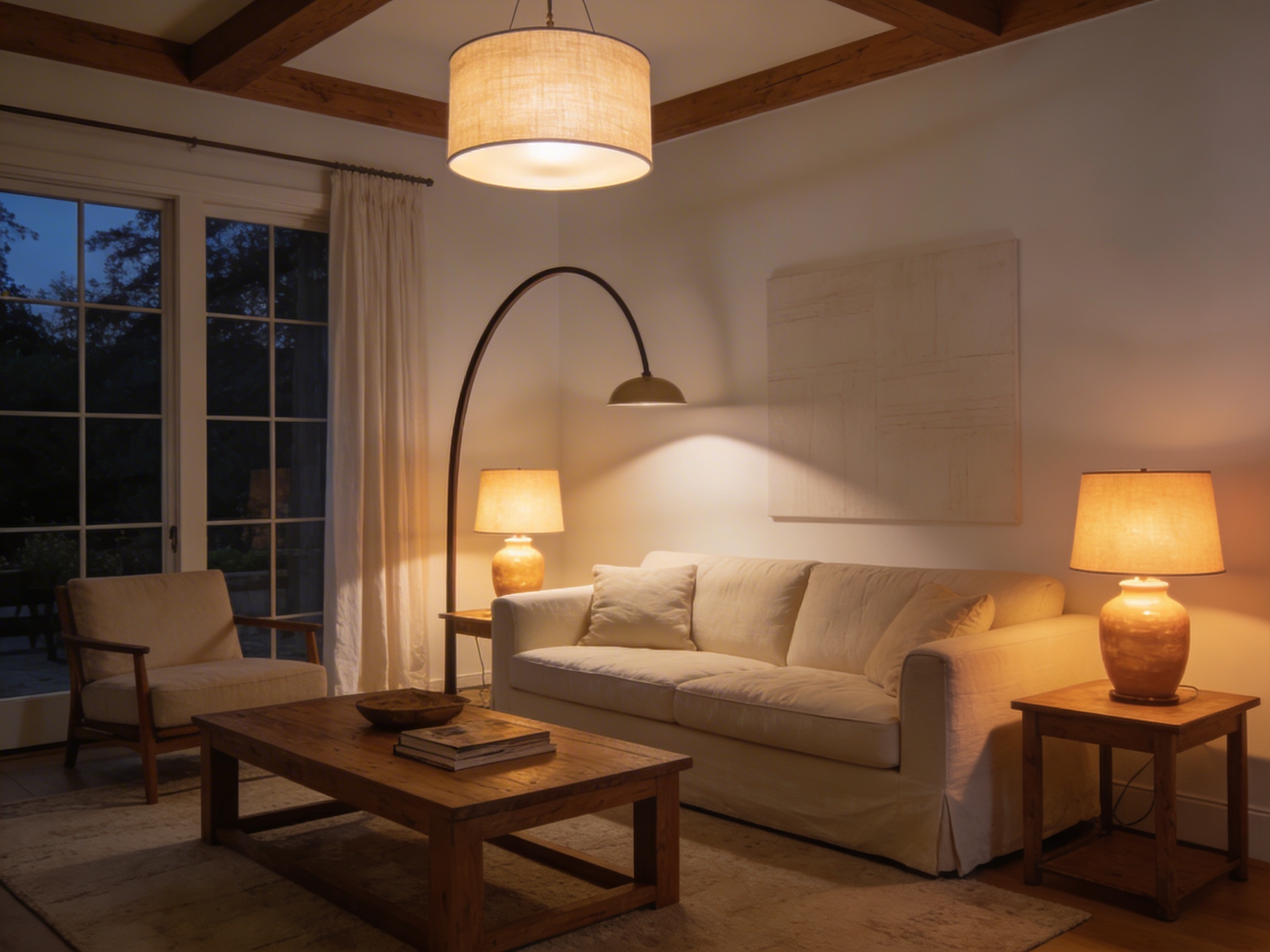
What's covered:
- Why overhead-only lighting fails
- The 3 layers of light every room needs
- How to layer lighting: a step-by-step plan
- Room-by-room lighting guide
- Kelvin & lumens: the numbers that actually matter
- Layered lighting on a budget
Why overhead-only lighting fails
A single ceiling fixture — whether it's a basic flush-mount, a recessed can, or even a basic chandelier — casts light downward from one angle. That creates harsh shadows under faces, eliminates depth and texture from walls and furniture, and makes every surface look equally flat. Interior design professionals consistently cite this as the #1 lighting mistake in American homes.
— Interior designers across the board, 2026
The "boob light" — that builder-grade frosted dome flush-mount on every bedroom ceiling in America — is now officially out. Design experts in 2026 are unanimous: it provides flat, unflattering illumination and adds zero character to a space. Even excessive recessed lighting — rows of can lights across the ceiling — has the same problem: it eliminates atmosphere instead of creating it.
The solution is not more overhead light. The solution is different kinds of light, in different places, at different intensities.
The 3 layers of light every room needs
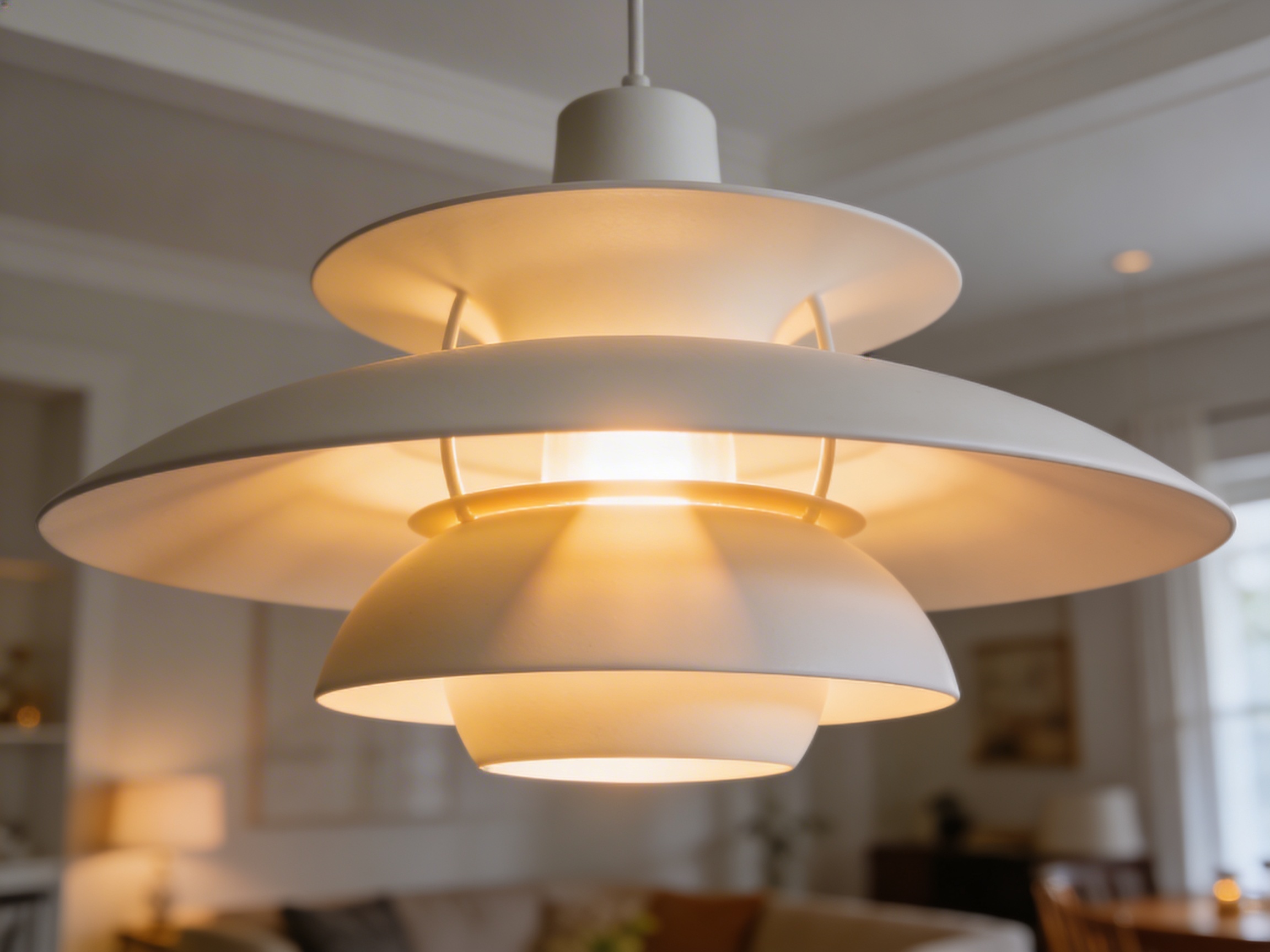
What it is: The general, overall illumination of a room. It sets the baseline brightness and tone.
Think: Ceiling fixtures, recessed lights, flush-mounts, chandeliers, semi-flush pendants
Goal: Even, soft light that fills the room without harsh shadows. This is your starting point — not your only point.
Kelvin: 2700K–3000K warm Dimmable: always
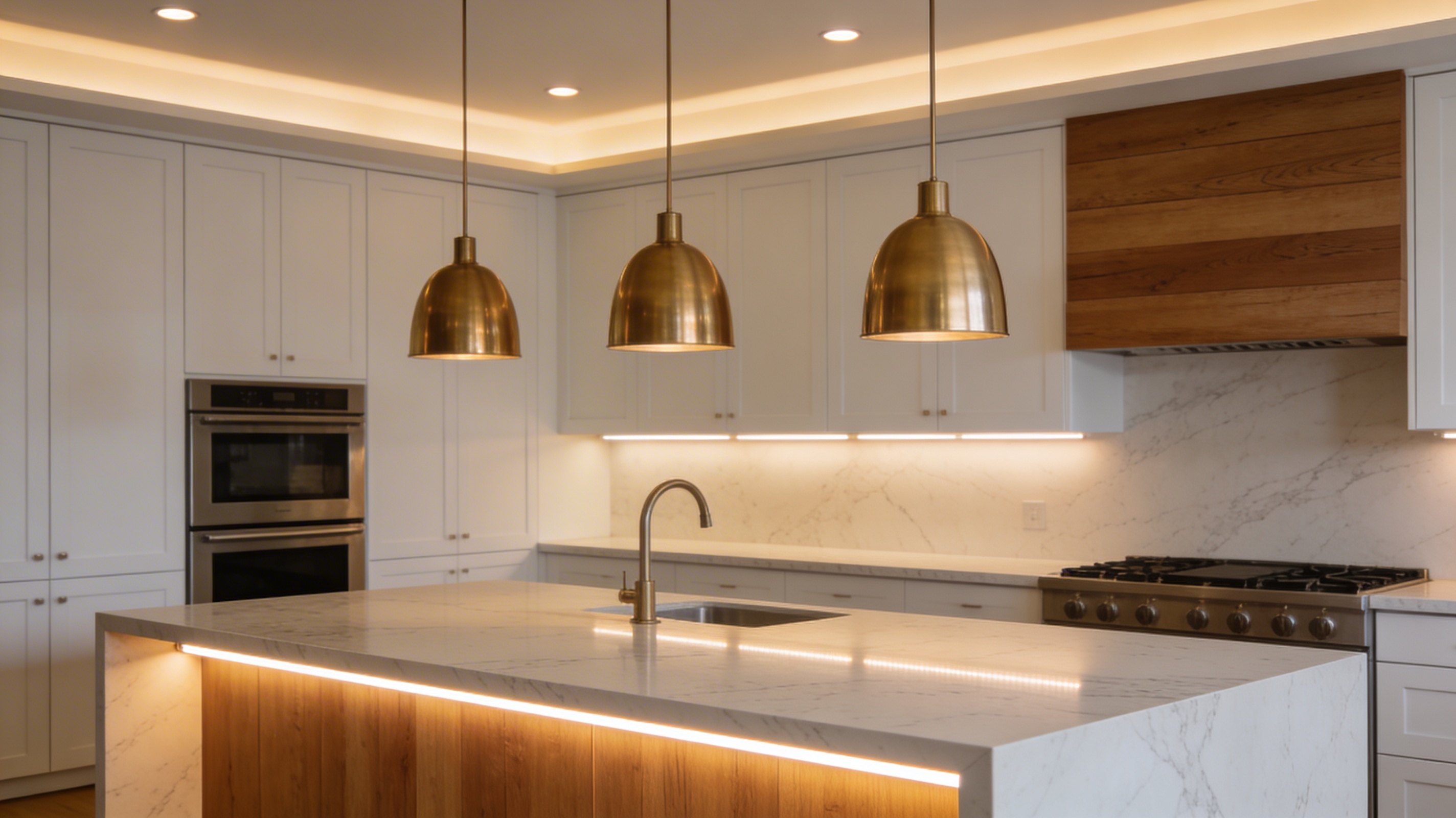
What it is: Focused, brighter light aimed exactly where you need it — for reading, cooking, applying makeup, or working.
Think: Under-cabinet strips, desk lamps, pendant lights over a kitchen island, bathroom mirror sconces
Goal: Eliminate shadows in work zones. Your ambient light alone cannot do this cleanly.
Kelvin: 3000K–4000K neutral Position: at eye level or directly above the task
What it is: Directional light used to highlight art, architectural features, plants, shelves, or textured walls. It adds depth, contrast, and visual interest.
Think: Picture lights, adjustable track heads, wall washers, in-cabinet LED strips, floor uplights
Goal: Create focal points and a sense of depth. This is the layer that makes rooms look like they belong in a magazine.
Intensity: 3× brighter than ambient on the target Angle: 30° from vertical is the sweet spot
How to layer lighting: a step-by-step plan
You don't need to rewire your home. Start with what you have and build up.
- Map your tasks and zones. Walk through each room and identify where people actually do things — read, cook, apply makeup, watch TV, work. Those spots need task lighting first.
- Establish your ambient base. Make sure your main ceiling fixture covers the room evenly. Add a dimmer if there isn't one. Warm white (2700K) makes almost every room feel better.
- Add task lighting where it's needed. A lamp next to the reading chair. Under-cabinet lights in the kitchen. A sconce at eye level next to the bathroom mirror.
- Introduce accent lighting for depth. Pick one or two focal points per room — a piece of art, a bookshelf, an architectural niche — and aim a light at it. The contrast does the heavy lifting.
- Put everything on dimmers or smart controls. Layered lighting only works if you can adjust the intensity of each zone. A "dinner" scene looks completely different from a "movie" scene — and both should be one button away.
Room-by-room lighting guide
| Room | Ambient | Task | Accent |
|---|---|---|---|
| Living Room | Dimmable ceiling fixture or semi-flush | Floor lamp next to sofa or armchair | Table lamps, wall sconces, LED shelf strips |
| Kitchen | Recessed lights or flush-mount (dimmable) | Under-cabinet strips, pendants over island | In-cabinet LED strips, toe-kick lights |
| Bedroom | Dimmable ceiling fixture or chandelier | Bedside lamps or wall-mounted reading lights | LED strip behind headboard, picture lights |
| Bathroom | Flush-mount overhead (dimmable) | Sconces at eye level on both sides of mirror | Toe-kick night light, back-lit mirror |
| Home Office | Overhead ambient (4000K neutral) | Adjustable desk lamp at workspace | Bias lighting behind monitor, shelf lights |
| Dining Room | Dimmable overhead or ceiling fan with light | Chandelier or pendant centered over table | Wall sconces, buffet lamps, candles |
Kelvin & lumens: the numbers that actually matter
Most Americans shop for light bulbs by wattage — a habit from the incandescent era that no longer makes sense with LED. The two numbers that actually determine how a light looks and feels are Kelvin (color temperature) and lumens (brightness).
| Kelvin Range | Color Appearance | Best For | Avoid In |
|---|---|---|---|
| 2700K | Warm white (incandescent feel) | Bedrooms, living rooms, dining rooms | Home offices, garages |
| 3000K | Soft white (warm but clean) | Kitchens, bathrooms, hallways | Spaces that need cool focus |
| 3500K–4000K | Neutral white (crisp, alert) | Home offices, craft rooms, garages | Bedrooms, cozy living spaces |
| 5000K+ | Daylight / cool white (clinical) | Workshops, utility rooms | Almost everywhere else in the home |
For lumens, a practical guide: 400–800 lumens per lamp is typical for accent and task lighting; 1,500–3,000+ lumens for ambient fixtures depending on room size. You do not need more lumens — you need the right lumens in the right place.
Layered lighting on a budget
You don't need a renovation to transform your lighting. The most impactful changes cost less than $100 per room and require no electrician.
- 🔌 Add a plug-in floor lamp — instantly creates a second light source with warm ambient fill (~$35–$80)
- 🎛️ Install a smart dimmer switch — turns your existing overhead fixture into a mood-adjustable light (~$20–$45)
- 💡 Swap bulbs to 2700K warm white LEDs — the single highest-impact, lowest-cost change you can make (~$10–$20)
- 🖼️ Add a plug-in picture light or wall sconce — introduces accent lighting without any wiring (~$30–$80)
- 🟡 Use LED strip lights behind furniture or under cabinets — adds depth and warmth for minimal cost (~$15–$40)
Browse our curated collection of dimmable ambient fixtures, plug-in sconces, pendant lights, and LED accent strips — everything you need to build a complete layered lighting plan in any room.
→ Shop All Lighting Fixtures
The bottom line
A single overhead light is not a lighting plan. It's a placeholder. The rooms that feel warm, inviting, and well-designed all share one thing in common: they use multiple light sources at different heights, in different intensities, for different purposes.
Layered lighting — ambient for coverage, task for function, accent for depth — is not a luxury reserved for interior designers or big renovation budgets. It's a system anyone can build, room by room, fixture by fixture, starting today. The difference in how your home feels is not subtle. It is immediate and dramatic.
Start with one room. Add one lamp. Install one dimmer. Then watch the rest of the room fall into place.
Frequently Asked Questions
Layered lighting is a design method that combines three distinct types of light — ambient (overall), task (functional), and accent (decorative) — each independently controlled, to create a room that is both functional and visually dynamic. It is the standard approach used by professional interior designers.
Most rooms benefit from at least 3–5 light sources: one ambient overhead fixture, one to two task lights positioned where activities happen, and one to two accent lights to add depth and highlight focal points. Small rooms like bathrooms can work with fewer; large open-plan spaces may need more.
2700K warm white is the most universally flattering choice for living rooms. It mimics the warmth of traditional incandescent bulbs and creates a cozy, inviting atmosphere. Avoid anything above 3500K in living spaces — it tends to feel clinical and cold.
Absolutely. Plug-in floor lamps, plug-in wall sconces, rechargeable cordless table lamps, and battery-powered LED puck lights all allow you to add layers of light without touching a single wire. This is especially practical for renters or anyone who wants to improve their lighting without a renovation.
Ambient lighting provides general, room-wide illumination — it's the base layer. Task lighting is focused and directed at a specific area where a visual task is performed, such as reading, cooking, or applying makeup. Both are essential; neither replaces the other.